One cheer for the WTO: Reflections from the field on MC14
In 1999, just four years after its creation, thousands of people turned out onto the streets of Seattle as the WTO’s Ministerial Conference rolled into town, to protest against the institution and its global extension of neoliberalism. Once viewed as a behemoth, part of Richard Peet’s famous ‘Unholy Trinity’ alongside the World Bank and IMF, the WTO today stands in stark contrast: dysfunctional, ideologically out of step with the times, and hated by its primary architect, the US. Indeed, it is not hard to find obituaries to the WTO.
The latest Ministerial Conference, MC14, was held in Yaoundé, Cameroon 26 to 29 March 2026 amid the ongoing dismantling by the Trump administration of the global trade system’s rules. The civil society presence was much diminished from the days of Seattle with closer to around a total of ten potential protestors. In the event, despite having been assured that they would be allowed to stage a small protest on the sidelines, tensions within the Cameroonian government over any form of protest saw that rescinded.
Expectations going into the conference were low. The largest issue on the table was, unsurprisingly given its problems, WTO reform, but there was no expectation of an agreement being reached - only a hope that a plan could be agreed for how negotiations on reform might be undertaken over the next two years. Alongside that two major agreements were on the table, on E-commerce and on Investment Facilitation for Development (IFD), that had been negotiated by a subset of members – plurilaterals as they are known in WTO parlance. It was hoped that agreement could be reached to have these added to the WTO legal architecture, requiring the acquiescence of all members due to the Organisation’s consensus rule, even when the agreements would only be applicable to their respective direct signatories.
At the event, nothing could be agreed, despite the negotiations being extended by nine hours – something that the Director General, Dr Ngozi Okonjo-Iweala, had repeatedly stressed in advance would not happen because of the disruptive effect it has on delegates and their travel plans. India stood almost alone to block the IFD agreement, despite it having the support of 129 members, including many developing countries including those from Africa, arguing that agreeing such plurilateral initiatives would effectively sideline critical concerns related to agriculture and development. The E-commerce agreement barely got examined before its 66 signatories declared that they would pursue its operationalisation outside the WTO.
Nothing was agreed on WTO reform, while perennial features of ministerial conferences, including the Moratorium on Digital Transmissions (under which countries agreed not to place tariffs on electronic data, such as streaming and downloading services) which had been renewed every two years for the last 30 years. Instead, the issue had to be sent back to Geneva to continue discussion.

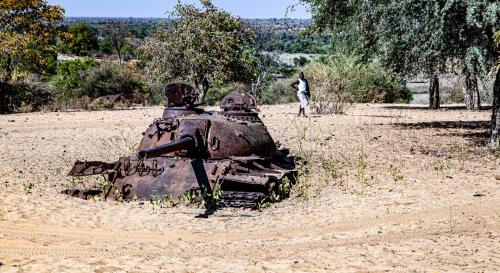
Photo: Erin Hannah in Cameroon
It is hard to see the MC as anything other than an abject failure, a klaxon call declaring the WTO’s complete inability to negotiate anything whatsoever. Attempts by the Secretariat to laud the adoption of a pathway to bringing the E-commerce agreement into force cannot hide the fact that the only way of doing so was to take it out of the WTO’s umbrella.
And yet, to declare the end of the WTO, for all its dysfunction, would be premature. All countries, including the US (which recently withdrew from 66 other international organisations) continue to engage on a day-to-day basis with the institution. The WTO’s committees continue to function, performing everyday global governance that solves trade tensions before they escalate into full-fledged disputes. To take one example, the Committee on Technical Barriers to Trade has heard 846 specific trade concerns (where one member raises an issue about another’s policies) since 1995, with just 57 of these being escalated to a full dispute settlement case. Furthermore, the US continues to be among those raising the most cases each year, indicating its belief in the value of the system. It is here, in the day-to-day, that trade problems are being addressed.
Crunch meetings like the WTO’s Ministerial Conferences and the high-politics they engender may be most conspicuous within trade affairs, but it is elsewhere that problems are resolved and international tensions eased. So while the WTO has undoubtedly been weakened by the failures of MC14, we should spare a moment to give at least one cheer to the nerds at work in Geneva, lost amid the minutia of unsexy technical work, who keep the wheels of global commerce turning as best they can while all around them the battle rages.
We would like to thank BISA for facilitating our attendance at MC14, by registering as an interested organisation and enabling us to attend as BISA representatives. Erin Hannah was funded by the Social Sciences and Humanities Council of Canada. James Scott was funded by King’s College London.