SOAS School of Methods - Critical reflections to carry through to doctoral studies
BISA recently partnered with SOAS, University of London to launch their first School of Methods. Some students were provided with BISA bursaries to attend, including Sadeen Haddad, who says the methods school provided her "with rich insights, important scholarship, and critical reflections that I will carry into my doctoral studies".
At the end of May, I attended the first SOAS School of Methods – a three-day methods school hosted at the School for Oriental and African Studies (SOAS) in London. My attendance was generously sponsored and made possible by BISA. This was an immensely informative experience that enriched my understanding on the use and application of different methods across positivist and interpretivist traditions. Most importantly, the methods school centralised the importance of approaching methods through a situated, context-sensitive lens. This focus underpinned discussions of methodological approaches spanning interviews, ethnography, and large-N quantitative research, and sparked discussions on the ebbs and flows of approaching methods through situated understanding and knowledge.
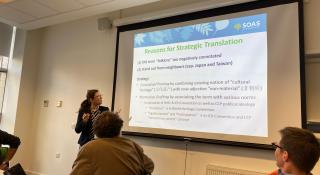
Over three days, the school guided us through the epistemological underpinnings of methodological approaches, and what it means to adopt a situated approach across different stages of a research project – from project design to fieldwork and analysis. Dr Tessa Devereaux and Professor Erica Simmon’s presentation on ‘Deciding Where to Work’ provided vital insights and raw discussion around the process of casing, and the importance of maintaining an awareness of prior assumptions that may inform our understanding of case studies and theorisation. We were reminded that there is no ‘view from nowhere’ and that incorporating reflexivity into research is a multidimensional, ongoing process that is not only necessary in the field, but rather throughout the lifespan of research projects where critical assessment of where knowledge comes from, how it is produced, and how we are contributing to it – including through methodological choices – is pertinent. This fed into our later session on ‘Methods, Colonization, and Decolonization’ led by Dr April Biccum and Dr Manjeet Ramgotra, where we delved further into the persisting impact of colonial legacies on knowledge production.

Image: The campus at SOAS, University of London.
Equally, the school provided room for open discussion around ethical challenges, through a session led by Dr Rebcca Tapscott and Dr Maya Nguyen titled ‘Situating Ethical Research’. This session allowed students and instructors to actively engage, and collectively reflect, on real-life examples of ethical barriers faced during or after fieldwork research. We then discussed the different ways of dealing with such challenges – allowing for reflexive discussion through these exercises. The last day of the methods school concluded with day-long breakout rooms, where I took part in the ‘Statistical and Experimental Methods’ session held by Dr Tolga Sinmazdemir. This was an extremely informative session where we discussed experimental and natural research designs, drawing on examples from Dr Sinmazdemir’s research on Syrian refugees in Turkey.
Concludingly, this was an immensely valuable experience. As a student of conflict studies, the honest discussions around ethical challenges was greatly informative to my understanding on how to approach my own future fieldwork. Further, the emphasis on critical engagement with methodological approaches and theorisation broadened my comprehension on how to think of research designs and the importance of consistently integrating reflexive practices. As I will be starting my PhD research in September, focusing on the dissemination and co-production of ideology within conflict-affected civilian communities in Lebanon, this methods school provided me with rich insights, important scholarship, and critical reflections that I will carry into my doctoral studies. Therefore, I am very grateful to BISA for sponsoring my participation, and for allowing me to be a part of this highly informative experience.