SOAS School of Methods - Refining methodological approaches to prepare for fieldwork
BISA recently partnered with SOAS, University of London to launch their first School of Methods. Some students were provided with BISA bursaries to attend, including Daniel Bioh, who reflects on how the course has helped him to prepare for fieldwork in Ghana.
Having started my PhD journey last year, my priority at this stage has been to make the most out of every possible opportunity to improve my project. For emphasis, I am researching electronic waste work and governance in Accra, specifically in terms of understanding how processes of circulation (how e-waste moves and the meanings it carries), circuits of capital (how people capture value and profits), and dispossession (the uneven spaces of privilege and exclusion that come with these) unfold in Accra’s e-waste economy. My overall motivation here is to draw lessons from these processes to enable deeper thinking about “green transition” initiatives. However, with such a project also comes the burden of learning, unlearning, and relearning for progress - the act of researching the research project itself. As part of this process, there was a need to refine my methodological approach as I prepare for fieldwork in Ghana later this year.
It is within this context that I found the SOAS School of Methods a timely and necessary opportunity for me to develop as a researcher. Through the scholarship offered by BISA, my participation in the programme became possible. The programme, delivered in person across a three-day period, was an enriching academic and personal experience.
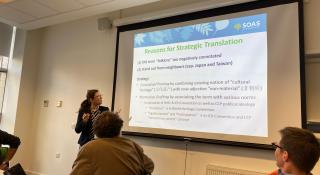
On the first day, renowned academics like Nick Cheesman and Nicholas Rush Smith provided an epistemological overview of situated knowledge. Before the session began, I had not anticipated any different mode of delivery from the normative PowerPoint approach. Yet, to my surprise, and I believe to that of many others, they delivered the session in the form of a constructive intellectual debate. Here, through the act of sharing opinions and taking constructive feedback, they operationalised the very idea of learning and unlearning, which they sought to emphasise as the basis for situated knowledge.
Another key reflection from the day came from the introduction of research projects by colleagues from different institutions across the UK. As I listened to others speak, it became clearer that, despite our diverse research paths, we were connected by a common thread of curiosity and determination in the pursuit of knowledge. Right from these introductions, my quest to expand my network began, but so too did a renewed sense of purpose as I moved through the remainder of the course.
Drawing from my experiences on day one, I entered day two with a specific motive: to learn as much as I could and to expand my network as much as possible. From the technical side ofthings, the focus of the day’s sessions was on designing a project from a situated perspective. We were introduced to diverse practical research activities, ranging from asking questions and conceptualising problems to deciding where to work. These sessions offered enriching experiences.
However, the highlights of the day for me were not just the discussions in the classroom, but also the extended meetings and conversations we had as colleagues during lunch and coffee breaks in the SOAS Brunei Gallery. Through these interactions, I made new friends from institutions all over the UK. We exchanged ideas that will continue to shape our respective projects in diverse ways. It was in this space that I met Tez from Cambridge and discussed our positionalities as African scholars researching Africa. Here, I also met a colleague from Glasgow, and we had exciting engagements ranging from academic discourses to our reflexive experiences of the city of Newcastle.
I refer to the final day as the special day, mainly because it was the day we focused on the specific methods for our PhD projects. Given that I will be engaging with ethnographic methods for my fieldwork in Accra, I joined the ethnography breakout module. Leading our session were Nick Cheesman and Salwa Ismail, two leading academics who had decades of fieldwork experience between them to share.
Here, we had detailed discussions about ethnography, ranging from the idea of truth and culture to navigating ethical dilemmas as ethnographers. As many of us shared in the Wrap-Up Discussion and Reflections session, this breakout module was an exceptional component of the programme because it offered an opportunity to tailor the broader discussions from the previous days to our specific research needs.
Overall, it was indeed an enriching experience to be part of this year’s SOAS School of Methods. I leave SOAS with invaluable research insights, but also with an expanded network of academics for future engagements and collaborations. I remain grateful to the team at BISA for making this possible.