SOAS School of Methods – 'A view from somewhere': Situatedness, ‘truth’, and the power of honest humiliation
BISA recently partnered with SOAS, University of London to launch their first School of Methods. Some students were provided with BISA bursaries to attend, including Phoebe Malone, who now discusses and reflects on the programme content from the course.
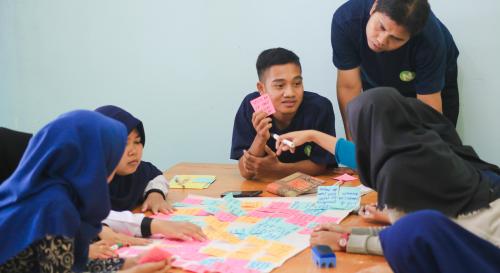
Thanks to the very generous sponsorship of my place at SOAS’ inaugural School of Methods, alongside that of Daniel’s (pictured above) and Sadeen’s whom I had the great pleasure of meeting there, I spent three days immersed in a nurturing yet critically engaging space where we collaboratively experimented in our thinking around methods. During these days, many different people and perspectives from all different stages of research came together to reflect on, debate, and create new ways of engaging in methods and methodologies outside of the dominant canons. From the first introductions, there was a real feeling of comradeship and a pulse of scholar-activism, where a shared eagerness to re-situate methods in ways that disrupt and challenge neocolonial and extractive traditions in the social sciences, and prefigure more just ways of working, united us. The school was introduced to us as a live intellectual co-production of ideas, and it really did feel like that- a place of reflexive, collaborative knowledge production. I admired and shadowed the honesty and transparency of those among me, and this admittance of uncertainty, discomfort, and sometimes humiliation during research only made the space more valuable and constructive to my thinking about practice. Being in the first year of my PhD research, currently planning my multi-site comparative ethnographic fieldwork for this upcoming autumn, being part of these discussions and conversations has felt extremely important and formative to the way I will approach my research.
‘A view from somewhere’
A motif that was a constant source of reflection and debate throughout all the sessions was the drive toward displacing a normative ‘view from nowhere’ with admittance and reflection on our inevitable ‘views from somewhere’ in any research. This ‘view from nowhere’ represents a falsely claimed possibility of neutrality and objectiveness in research which, whilst being largely discredited across social sciences, can be seen to creep in through silences and assumptions. One of the main ways we reflected on how researchers do not fulfil the responsibility of actively situating themselves and their research practices as intrinsically representing a ‘view from somewhere’, is via omissions throughout writing on methodology that recognise and honestly reflect on one’s physical and discursive loci that constitute and shape your ‘ways of knowing’ and interacting. Indeed, who you are shapes how you conduct research and what knowledge you construct alongside interlocuters.
Throughout the school, scholars constantly nodded to the ways in which knowledge is situated. For example, Tolga Sinmazdemir and Nicholas Rush Smith opened their session on ‘Thinking about Causes’ with the question ‘what caused World War I?’. The ensuing discussion demonstrated how there is a ‘normal’ story, and then infinite others, which leads us to question what actually constitutes a ‘cause’ and what ‘causation’ means to different people from different loci of views, which are always power-laden.
This also led to fascinating discussion of Thea Riofrancos’ (2021) work ‘From Cases to Sites’, leading on from our discussion on how whilst there have been many ‘world wars’, only two have been ‘cased’ as world wars. Whilst ‘casing’ claims to offer singular representations of a generalisable phenomenon, ‘siting’ offer abductive analysis through iterative encounters, and reveals how local events are constitutive rather than representative of a larger phenomenon. This made me think of Gillian Hart’s (2018) work on relational comparison, which is useful to read alongside Nick Cheesman’s (2021) work on ‘unbounded comparison’ and Erica Simmons and Nicholas Rush Smith’s (2017) work on ‘comparison with an ethnographic sensibility’. It was really powerful to listen to Nick, Erica, and Nicholas discuss these ideas live in the room with us at SOAS. Further, another conversation which was embedded across the three days was around how each loci and each meaning and explanation of ‘cause’ represents and reflects power, and how racialisation and neocolonialism remain intricately involved in institutional knowledge production. April Biccum and Manjeet Ramgotra led an extremely important session on decolonising knowledge, speaking with urgency in a moment when far-right populist moves toward anti-intellectualism are forming part of the crisis in higher education. These discussions which were introduced at the beginning of the school are deeply entwined with ‘truth’ in ethnographic research, which was the subject of the final day.
‘Culture’, ‘truth’, and humiliation
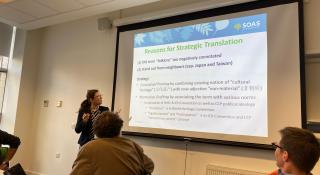
Whilst the first day of the school looked mainly at epistemology, the second day more intricately examining the constitutive role of ‘place’ in epistemologies, the third and final day offered a choice for attendees between day-long breakout sessions of specific methods. I attended Salwa Ismail’s and Nick Cheesman’s session on Ethnographic Methods. From the outset, ‘culture’ and ‘truth’ were introduced as organising themes for our discussion. We spoke about how, much like normative ‘views from nowhere’, whilst essentialist concepts of culture are largely discredited now, they still find their way into much dominant media, discourse, and literature, and even the interpretive approach to culture can be problematic. Whilst an interpretive approach looks for signs, symbols, and meanings, this also leads researchers to a belief that they can finally ‘understand’ or ‘grasp’ these signs, symbols, and meanings, which assumes there is a true ‘culture’ waiting there to be discovered and understood. Meaning is historical and social in itself, and differs in exponential ways in any one given moment. They drew on Lila Abu-Lughod’s works ‘Do Muslim Women Need Saving’?’ (2013), and ‘Writing Against Culture’ (1991) to demonstrate how the same ‘symbols’ or ‘signs’, the veil for instance, mean different and often directly opposing things to different individuals. Salwa drew on an example from her own work to warn against typifying or claiming characteristics of someone or something. In Cairo, the same person can appear as a ‘thug’, a ‘mediator’, or a ‘chivalrous gentleman’ in different areas. This then led discussion onto ‘truth’, and how the anthropologist’s job, rather than deciding which of these descriptors is most ‘truthful’ or close to ‘reality’, is to trace what certain social positions, narratives and views are expressive of. The task is to investigate why these different contexts assign different meanings to the same person. Salwa and Nick advocated for how ‘culture’ cannot be abandoned altogether, but rather viewed as a generative and semiotic concept.
Toward the end of this session, during a debate over positionality in anthropological research, there was a particular comment that really resonated with me and which I will certainly take forward with me. Ethnographers incorporate into their writing parts of their experiences that researchers from other disciplines would likely omit due to humiliation or anxiety retelling imperfect examples of fieldwork. However, including these details is far more valuable than writing a generic positionality statement, as it lucidly demonstrates exactly how one’s presence in the field impacts oneself and others.
‘Getting past the graveyard of dreams’
One of countless other lessons I absorbed during this programme, which will certainly stay with me, was shared with us by the inspiring scholar Joe Soss, in his talk with the incredible Lester Spence. Joe encouraged us not to let goal displacement happen whilst choosing research questions- to not let feasibility and precise language completely distance you from talking about what you really care about. Joe spoke about how, far from ever working from a research agenda, his research has always been compelled from anger or outrage, and thus we must base our research questions on what seems most able to disrupt, challenge and intervene. Rather than asking what our contribution is, we must ask what our intervention is, and in this way we must not accept that a ‘graveyard of dreams’ is necessary to narrowing our research questions. Joe reminded us to keep our wits about us: when people ask you to generalise something, what they are often actually saying is ‘can you change your question into something legible to my standpoint and something that I care about’. In this way, generalisability is often about power. Our challenge is not to find a way of accepting the throwing of our dreams into a graveyard to conform with institutional research procedures and our superiors, but rather to make what compels us, also compelling to others. In order to do this, Joe reflected on his ‘ask your elders’ technique as a way to speak to others- conceptualise your questions differently and present it across different levels of abstraction by asking how other theorists would think about it- both theorists you admire, and those you do not. Whilst sometimes there is great power in refusing legibility in decolonial knowledge production, there are also many instances where challenging language and canons used in the academy requires a skilful and strategic adaptability to compel wide audiences.
It was truly difficult to select just a few learnings from the SOAS School of Methods, and to explain their impact on me in such limited words. I am extremely grateful to BISA to have been given the chance to attend such a transformative event, and to meet such incredible individuals.